Showing posts with label doodle. Show all posts

Wednesday, January 11, 2012

Google Doodle: Nicolas Steno friend of Nicolaes Witsen

Google Doodle - 1/11/2012
Today's Google doodle marks the birthday of Nicolas Steno,  a physician and scientist in the early Age of Enlightenment.  He made contributions to geology, crystallography and anatomy.   He knew several scientific luminaries of the age including the cartographer and Mayor of Amsterdam,  Nicolaes Witsen.   At the University of Copenhagen, he met Thomas Bartholin, discoverer of the lymphatic system and the father of  Caspar Junior who described Bartholin's glands, two glands located slightly posterior and to the left and right of the opening of the vagina. 

Steno tried organized religion and found it wanting. Ironically, he may land up being made a saint by a large religious organization.

Monday, November 7, 2011

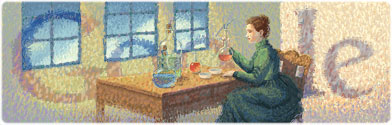
Marie Curie - Google Doodle

 Today's Google Doodle is about Marie Curie (144th birthday).

Google Doodle - Marie Curie.
 Marie Curie was the first person to win two Nobel Prizes in science.   The others are  John Bardeen (Physics) and  Frederick Sanger (Chemistry) .  Linus Pauling won his first Nobel in chemistry and his second for Peace. He perhaps should have received two just for inventing chemistry.  :) 

Marie's daughter, Irene Joliot-Curie  won the Nobel prize in Chemistry with her husband,  Frederick Joliot-Curie (nee Joliot) .

Wednesday, July 20, 2011

Third Anniversary of Chemo - Gregor Mendel - Google Doodle

 Today is the "official" third  anniversary of the end my chemo in 2008 - and 3.5 years from surgery.   To quote Galileo  - from the Italian - "E pur si muove"  ("And yet, it moves" -  in this case time).

I found peas on Google's home page this morning.    Here's what it looked like.
the "Google doodle" commemorates the birth of Gregor Mendel,  father of modern genetics.   Mendel did most of his work with pea plants and documented the patterns and statistics of traits he observed (phenotypes) based on their parental traits. From these observations, he inferred what is known now as the Laws of Mendelian Inheritance.  He observed that traits are not blends of parental ones but specific characteristics  (either there or not with specific frequencies).  He posited that factors for each trait are inherited from each parent but separately (segregation).  And that traits are not inherited as a group but  independently (independent assortment).   As the microscopic and molecular aspects of genetics where later elucidated,  the mechanisms for Mendel's laws became apparent.  We now know that many phenotypes are transmitted in much more complex ways (non-Mendelian inheritance).